How to Choose Dimmable String Lights for a Patio
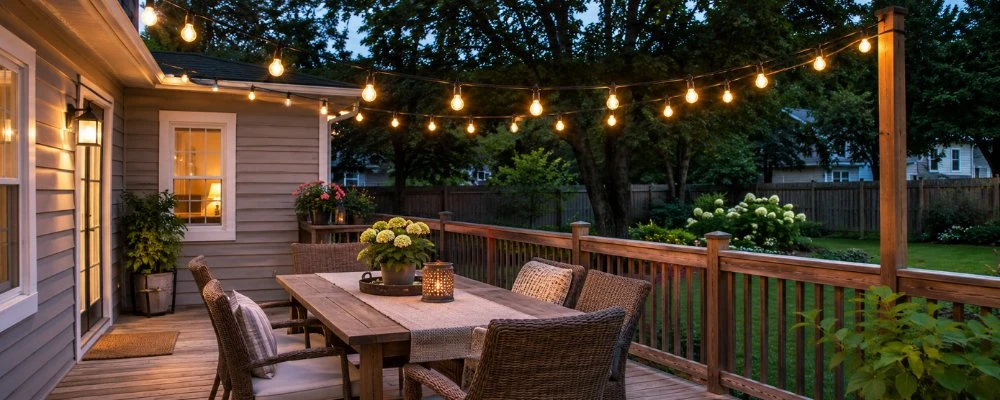
Choosing dimmable string lights means checking more than whether a package says “dimmable.” The string, bulbs, and dimmer must work together as a compatible system. You’ll also want to plan the bulb spacing and total run, support the installation correctly, and confirm that the lights and electrical connections suit the outdoor conditions.
These steps apply to bulb string lights, also called patio or cafe lights, not rope lighting, which uses a continuous flexible tube or strip of light.
1. Check the Complete Dimming Setup
Match the String, Bulbs, and Dimmer
Dimming compatibility depends on the exact light string, the bulbs installed in it, and the dimmer. An LED bulb may be dimmable on its own but still flicker, buzz, drop out, or have a limited dimming range when paired with an incompatible control.
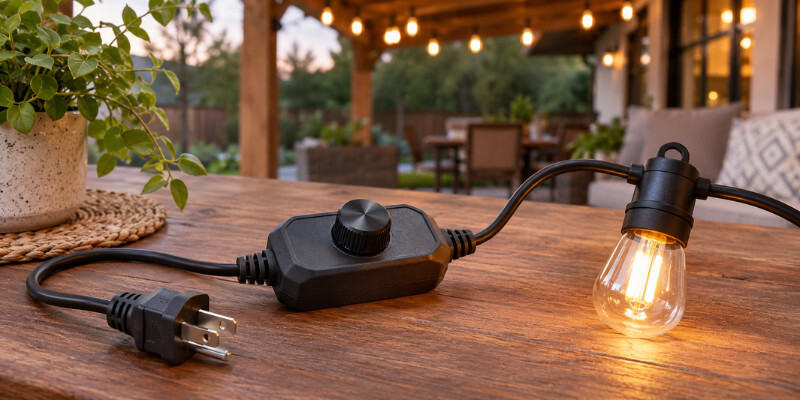
Before buying, check the manufacturer’s instructions for the string and bulbs. Then confirm that the dimmer is approved for that LED load and type of control. A wall dimmer, plug-in controller, and remote dimmer are different products; one should not be substituted for another unless the manufacturer says it is compatible.
For the OSL-S14, AQLighting’s product information describes it as a 120V dimmable outdoor LED patio string light. The product page offers dimmer options, while its spec sheet lists full-range dimming with a CFL/LED dimmer. Check the current product configuration and instructions to confirm the right dimmer and bulb combination for the setup you’re ordering.
Choose The Light Output and Atmosphere
Consider how you’ll use the patio. A dining area may need brighter light for serving and conversation, with a lower setting for relaxed evenings. Bulb brightness, color temperature, spacing, and the dimmer’s usable range all affect the result.
For example, the OSL-S14 spec sheet lists warm white 2700K S14 bulbs at 150 lumens per bulb. Those are product-specific details, not a general promise about every patio string light.
2. Plan Bulb Spacing and Total Run Length
Measure The Route, Not Just The Patio
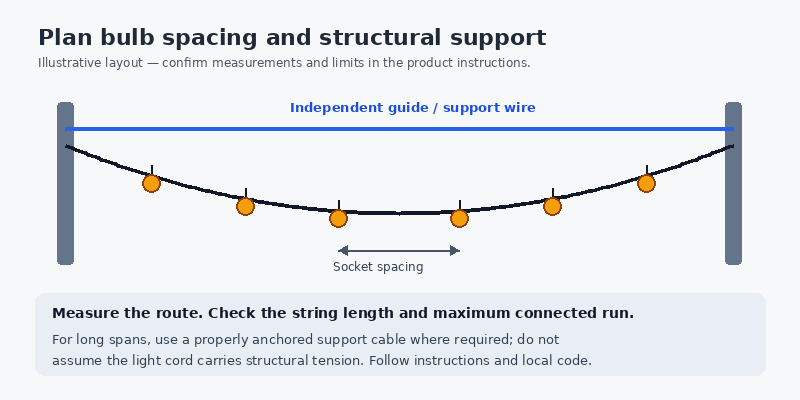
Measure the actual path the string will follow, including turns and any intentional dip between supports. Compare that measurement with the available string lengths and socket spacing. Closer spacing puts more bulbs along a run; wider spacing spreads the light points farther apart.
The OSL-S14 spec sheet lists configurations with 24-inch spacing and a 48-inch (about 4-foot) spacing option, with different bulb counts and string lengths. Use the exact product configuration you select when estimating coverage.
Check the maximum connected run
If you plan to connect multiple strings, follow the manufacturer’s maximum connected run and electrical load limits. Do not assume that strings with the same style of connector can be safely combined in any quantity. If the layout is large or will operate for long hours, confirm the plan with the manufacturer or a qualified electrician.
3. Support The Lights Securely
Use a Guide Wire For Long or Tensioned Spans
For longer spans or installations exposed to wind, plan how the lights will be supported. A properly installed guide or support wire can carry the mechanical load, leaving the light string to hang from it as directed by the product instructions. Use anchors and attachment points suited to the structure and expected load.
Do not assume the electrical cord is designed to act as a structural cable. Follow the light manufacturer’s mounting instructions, and avoid attaching lights to weak trim, gutters, or other surfaces that are not intended to carry the load. UL Solutions notes that listed string lights still need to be installed according to their instructions and applicable electrical codes.
4. Confirm Outdoor Suitability and Outlet protection
Check The Product’s Outdoor Rating and Condition
Look for the manufacturer’s stated outdoor-use suitability and the rating or marking that fits your installation’s exposure. A covered porch and an area open to rain may need different protection. Check the full system, including bulbs, sockets, connectors, and any dimmer or extension cord, rather than assuming that one outdoor-rated component makes every connected part suitable.
Inspect the cord, plugs, sockets, and bulbs before use. Do not use a string with cracked insulation, exposed wire, broken sockets, or damaged connectors.
Use GFCI Protection and Protect Connections
Outdoor outlets should have GFCI protection. The U.S. Consumer Product Safety Commission also recommends weatherproof outlet covers, including covers designed to remain weatherproof while a cord is plugged in where needed. Keep plugs and connections protected from moisture, and use extension cords marked for outdoor use when the product instructions allow them.
Quick Compatibility Checklist
Before you buy or install dimmable outdoor string lights, confirm:
- The string, bulbs, and dimmer are explicitly compatible.
- The dimmer is suitable for the LED load and control type.
- The bulb style, brightness, and spacing fit the patio.
- The string length and maximum connected run match the layout.
- The product is marked for the outdoor exposure where it will be installed.
- A separate support wire is planned where the installation requires it.
- The outlet has GFCI protection and the connections can be kept protected from moisture.
- The instructions and local requirements are followed for the planned installation.
When To Call a Licensed Electrician
Hire a licensed electrician if the project requires new wiring, a new outdoor receptacle, a hardwired dimmer, work inside an electrical box, or changes to a building’s electrical system. It’s also sensible to get professional help if you’re unsure about the existing outlet’s GFCI protection, load limits, mounting structure, or local code requirements.
For a restaurant patio, coordinate the plan with a licensed electrician and check applicable local requirements before installation. Commercial use may involve longer operating hours, larger connected loads, or more permanent mounting than a typical home setup.
For more options, browse LED String Lights. For a commercial-ready dimmable patio string light, see AQLighting OSL-S14.
FAQs
➜ What should I check before buying dimmable string lights?
Confirm that the exact string, bulbs, and dimmer are compatible. Then check the outdoor-use rating, bulb spacing, total length, and maximum connected run.
➜ Can I use any LED dimmer with patio string lights?
No. LED dimmers vary, and compatibility depends on the specific string and bulbs. Follow the manufacturer’s compatibility guidance for the exact dimmer and lighting setup.
➜ Do outdoor string lights need GFCI protection?
Outdoor outlets should have GFCI protection. The CPSC recommends GFCI protection for outdoor outlets and weatherproof covers appropriate to how the outlet is used.
➜ Should patio string lights hang from a guide wire?
A guide wire can support longer or tensioned spans when the installation requires it. Follow the product’s mounting instructions and use secure anchors; do not assume the electrical cord is a structural support.
➜ Are patio string lights the same as rope lights?
No. Patio string lights have separate bulbs mounted along a cord. Rope lights use a continuous flexible tube or strip of light and have different installation and electrical requirements.