Rope Lights Outdoor Waterproof: Uses, Placement & Buying Tips
AQ Lighting Oct 27th 2026

Outdoor rope lights can outline a deck, soften a patio, or highlight a pergola with a continuous line of light. The right choice depends on more than a product being labeled “waterproof.” Check its IP rating, the exposure at the installation site, the protection of its connectors and power components, and its voltage and maximum run.
For exposed outdoor areas, choose rope lights outdoor waterproof with a rating suited to the installation. An IP65 rating means the light is dust-tight and protected against water jets, but it does not mean the rope light can be submerged. AQLighting’s Endura rope-light listing, for example, identifies the product as IP65 and non-submersible.
Where do outdoor rope lights work well?
Rope lights are flexible linear lights: small LEDs sit inside a protective tube, producing a continuous accent. They work best when the goal is to define an edge or add ambiance. They are not automatically bright enough to replace dedicated safety, task, or pathway lighting.
Common placements include:
- Decks and patios: Run the light along a railing, stair skirt, or perimeter to define the space after dark.
- Pergolas and gazebos: Follow a beam or outer edge for a subtle architectural outline.
- Fences and garden borders: Highlight a boundary or decorative feature without adding bulky fixtures.
- Storefronts and hospitality spaces: Outline windows, awnings, counters, or exterior architectural details.
- Steps and walkways: Use a properly selected and mounted rope light as a visual accent. For dependable footing, pair it with lighting designed to provide functional visibility.
For a softer, less direct effect, mount the rope under a rail lip or inside a channel so the light source is less visible. For a crisp outline, use mounting clips or a track to keep the run straight and secure.
What does “waterproof” mean for rope lights?
“Waterproof” is not a universal promise that a light can withstand every kind of water exposure. IP ratings classify protection provided by an enclosure. In an IP65 code, the first digit refers to solid-object protection and the second to water protection; IEC guidance identifies IP65 as dust-tight and protected against water jets. It does not establish that the product is suitable for immersion.
Before purchasing, check the product’s rating and the manufacturer’s description for the complete setup. The tube, end cap, power cord, connectors, controller, and power supply may not all share the same rating. Keep plugs and connections in the location and orientation specified by the manufacturer, and do not place them where water can pool.
For a poolside installation, distinguish between “near a pool” and “underwater.” A rope light rated for outdoor exposure is not automatically rated for submersion or installation where it may be continuously wet. Use products specifically documented for the application, and follow their installation instructions.
How to choose the right outdoor rope light
| Check |
What to confirm |
| Exposure |
Is the location covered, exposed to rain, or likely to collect standing water? Match the product rating and instructions to that exposure. |
| Voltage |
Confirm whether the model uses line voltage, such as 120V AC, or a low-voltage power supply. Use only its specified power components. |
| Length and maximum run |
Measure the full route, including corners and the path to the outlet. Stay within the manufacturer’s maximum run. |
| Cutting and connections |
Check whether the model is cuttable and where its marked cut points are. Use compatible connectors, end caps, and sealing components. |
| Brightness and purpose |
Rope lights usually provide accent illumination. Check published light output if you need more than a decorative glow. |
| Color and dimming |
Choose a color suited to the space, then verify dimming support and compatible controllers or dimmers. |
| Mounting |
Confirm the rope’s diameter and whether clips or a mounting channel are recommended or included. |
| Outdoor durability |
Check product-specific information such as UV protection, temperature range, location rating, and applicable listing or certification. |
AQLighting’s Endura example is listed as 120V AC, IP65, cuttable at marked intervals, dimmable, and limited to a 150-foot run. Those details apply to that model; they should not be assumed for every rope light in the category.
How should you plan placement?
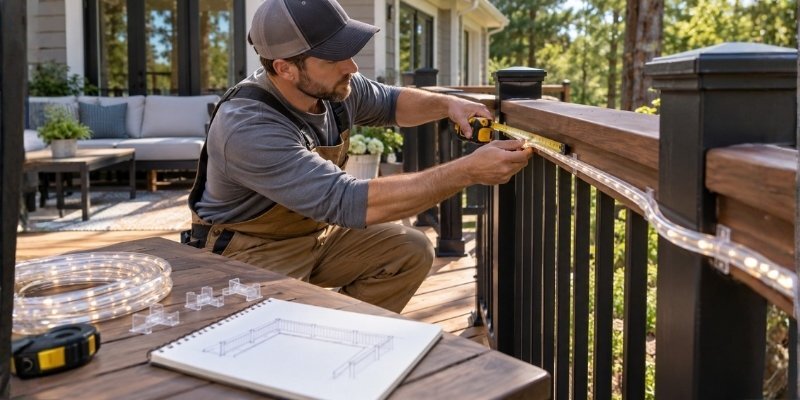
Start by measuring the route and locating the nearest suitable power source. Sketch the path before mounting the light, and note corners, transitions, and where the power connection will sit. Leave enough room for the product’s specified bend radius; forcing a sharp bend can damage the tubing or internal wiring.
Use the mounting clips or track intended for the product. Do not use nails, staples, or fasteners that could pierce the insulation. If the light can be cut, cut only at the model’s marked points and install the matching end cap and connection kit. AQLighting’s FAQ also notes that rope-light cut marks and power connections are product-specific.
Check the plug, connection, and power supply placement before finishing the run. Outdoor electrical decorations should be connected to GFCI-protected circuits, and outdoor cords should be marked for outdoor use. Keep cords clear of standing water and inspect them for damage.
For permanent wiring, uncertain voltage or dimmer compatibility, or installations governed by local electrical requirements, consult a qualified electrician. This guide is general product-selection information, not project-specific electrical advice.
Common buying mistakes to avoid
- Choosing by the word “waterproof” alone: Verify the rating and what parts of the system it covers.
- Assuming all rope lights can be cut: Some models are cuttable only at marked intervals; others should not be cut.
- Ignoring the connector and power supply: A rated light tube does not make every plug or connection suitable for exposed placement.
- Exceeding the maximum run: Long runs can exceed a product’s stated limits or require a particular configuration.
- Expecting accent light to replace task lighting: A glowing outline may look attractive without providing enough light to safely navigate steps or perform work.
- Using an incompatible dimmer: Confirm the product’s dimming method and recommended controller before installation.
Find an outdoor rope light for your project
Once you know the installation location, required length, power source, and exposure conditions, compare models by their individual specifications. Browse AQLighting’s rope-light selection for 120V, low-voltage, custom-cut, and other options. Before ordering, check the relevant product page for its rating, cut instructions, maximum run, and compatible accessories.
FAQs
➜ Are outdoor rope lights waterproof?
Some are designed for outdoor use, but the protection level varies by model. Check the IP rating and the manufacturer’s instructions for the light, connectors, end caps, and power supply.
➜ Can IP65 rope lights be submerged?
No. IP65 indicates dust-tight protection and protection against water jets; it does not mean the product is submersible.
➜ Can I cut outdoor LED rope lights to fit?
Only if the specific model is cuttable, and only at its marked cut points. Use its specified connector and end-cap components after cutting.
➜ Can rope lights provide enough light for outdoor steps?
They can mark an edge or add a visual accent, but output varies. If the steps need functional visibility, use lighting designed for that purpose and treat rope light as supplemental.
➜ What should I check before installing rope lights outdoors?
Confirm outdoor suitability, voltage, maximum run, mounting method, and connector placement. Use GFCI protection and outdoor-rated cords where applicable; consult an electrician for permanent wiring or code questions.